
virasight-7-reasons
Wearables · Buying guide
7 reasons people are putting the camera on their face instead of in their hand
Every argument below can be checked. Three of them you can test on your own phone in under a minute, before spending anything.
Open your camera roll and scroll back to the last event you actually cared about. A birthday, a trip, someone's first day at something.
Count the near duplicates. Three shots of the same cake. Four of the same street. That is not indecision. It is what happens when nobody trusts the first attempt without checking the screen, and checking the screen is the part that costs you the moment.
Then look at where the camera was standing. Chest height. Tilted up. Framed by an arm rather than by an eye.
Nothing in that camera roll is a camera problem. Every phone sold in the last five years takes a better photograph than any of it needed. The problem sits somewhere else, and it explains why a $1,200 phone keeps losing to a $114 pair of glasses on the one measurement that decides everything.
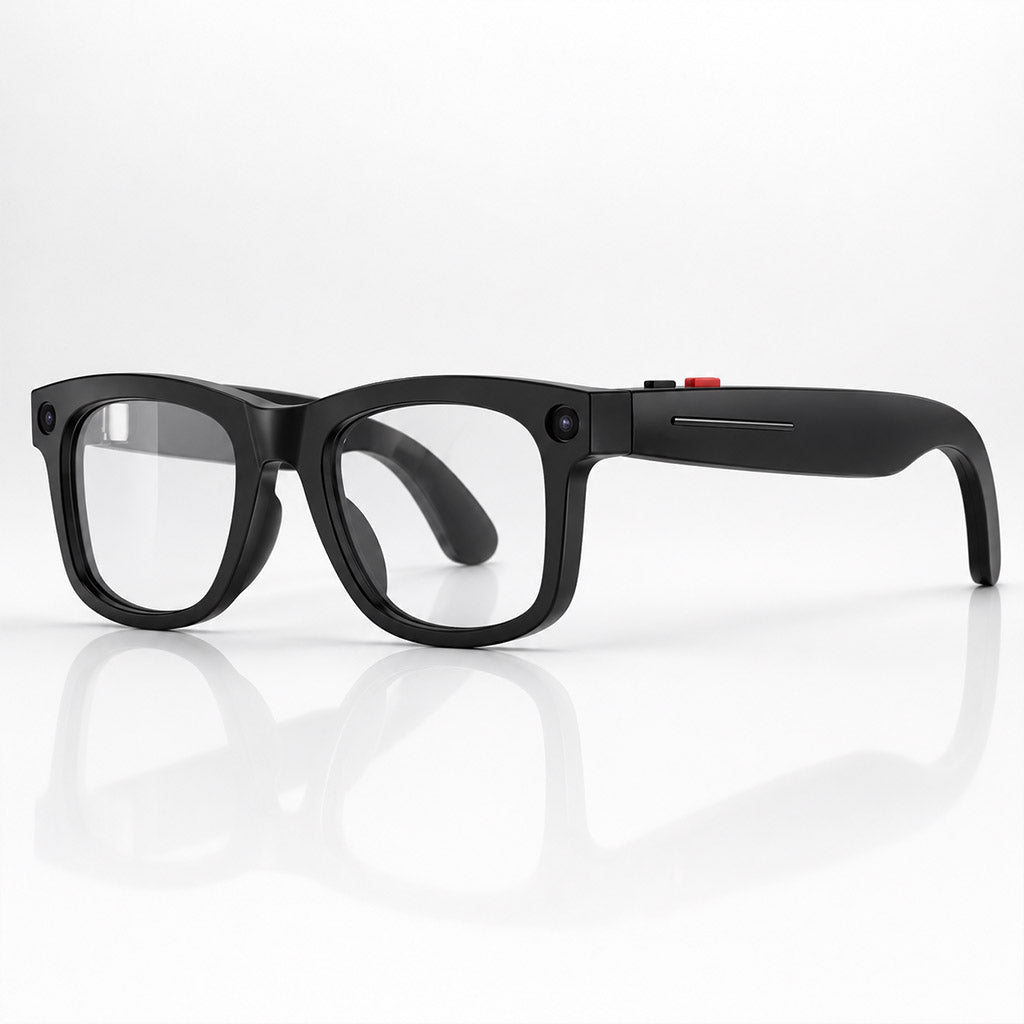
Vira Sight AI Smart Glasses
Classic square frame · 3 colourways
$114
- 5MP camera, 1080p video with anti shake
- Live translation across 25 languages
- Clear lens plus two clip on tinted sets
- Front facing indicator light while recording
30 day returns · 12 month warranty
Free shipping over $150
Here are the seven reasons that keep coming up, with the evidence for each.
01
Capture and attention compete for the same hand
No improvement to a phone camera can fix this, because the constraint was never optical. It is a scheduling conflict, and both tasks want the same eyes.
Count the steps honestly. Unlock, open the camera, frame, shoot, check the result. Fifteen to thirty seconds each time, and most people repeat the whole sequence two or three times before they trust the shot. Do that six times during a two hour party and roughly three minutes of it happened behind a screen.
Those three minutes are not randomly distributed. They land on the moments someone judged worth keeping, which makes them precisely the moments they were least present for.
02
Every hands free alternative has already failed, and the reason is measurable
Action cameras, head straps, chest mounts and gimbals all record well. None of them solved this, and the failure has a common shape: each one asks you to decide in advance that the next hour deserves setting up. Almost nothing worth recording gives that much notice.
- Action cameras. Excellent footage, and a social problem. They read as equipment, so nobody wears one to dinner, to a school recital, or through a market.
- Head straps and chest mounts. Rigging takes longer than the moment lasts. By the time it is on, the thing you wanted has finished.
- Phone gimbals. Smoother video, but a hand is still occupied and a screen still sits between you and the subject.
- Earlier camera glasses. Heavy, unmistakably a gadget, and priced like a laptop for a sensor that would embarrass a modern phone.
Run the arithmetic on adoption rather than specifications. A 4K camera used twice a year produces two recordings. A 1080p camera worn on three hundred ordinary days produces whatever happened on three hundred ordinary days. That comparison is not close, and no specification sheet measures it.
03
It records the angle you actually saw
There is a reason almost every photograph of a small child looks alike. It was taken from roughly forty centimetres above their head, because that is where an adult arm reaches. The angle was never chosen. It is a constraint of holding the device.
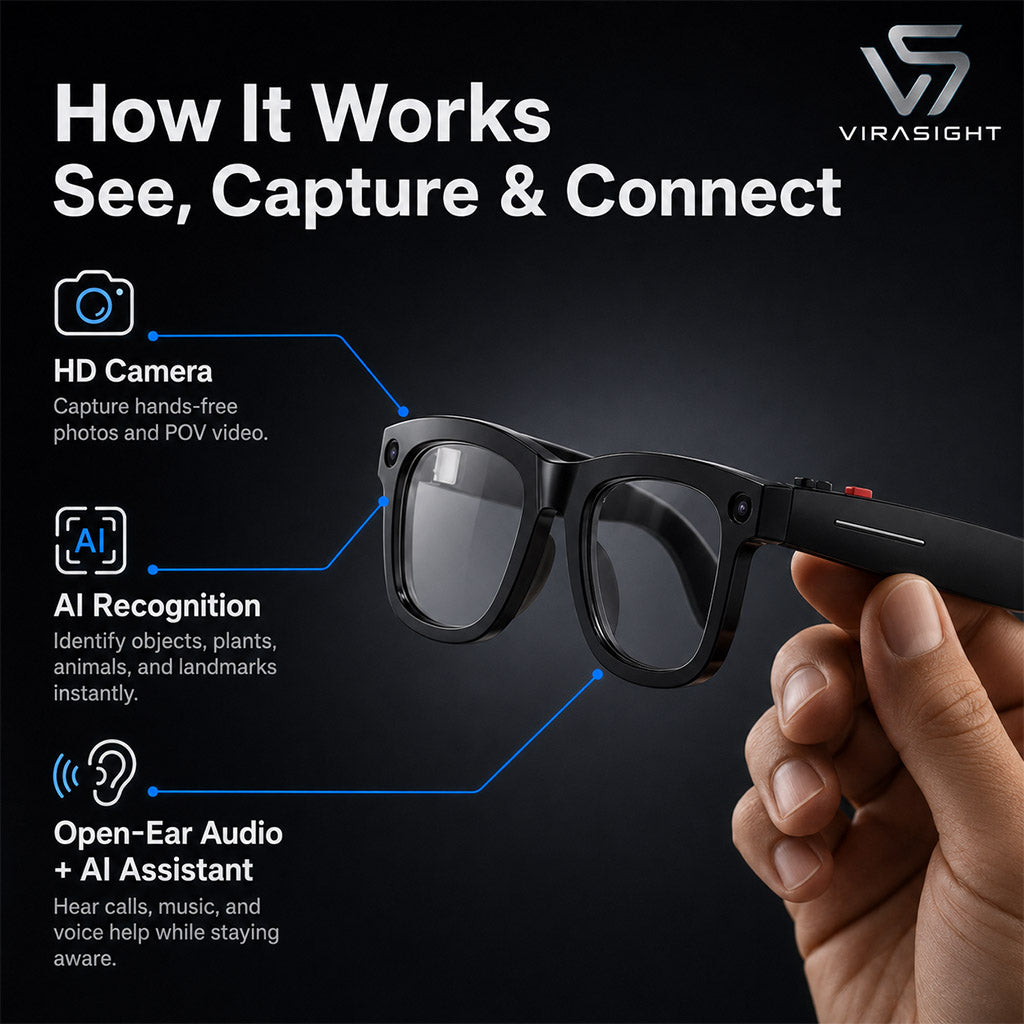
Glasses record at eye level, aimed at whatever held your attention, because attention is what aims them. The frame captures 5MP stills and 1080p video with anti shake stabilisation. Stabilisation matters more here than resolution does. Walking footage without it is unwatchable, and walking is exactly when first person footage gets shot.
04
The specification that predicts use is whether anyone remarks on it
A classic square frame in matte black passes at conversational distance. No headband, no visible battery pack, no module sticking out of the temple. People sit across from it and say nothing, which is the entire requirement.
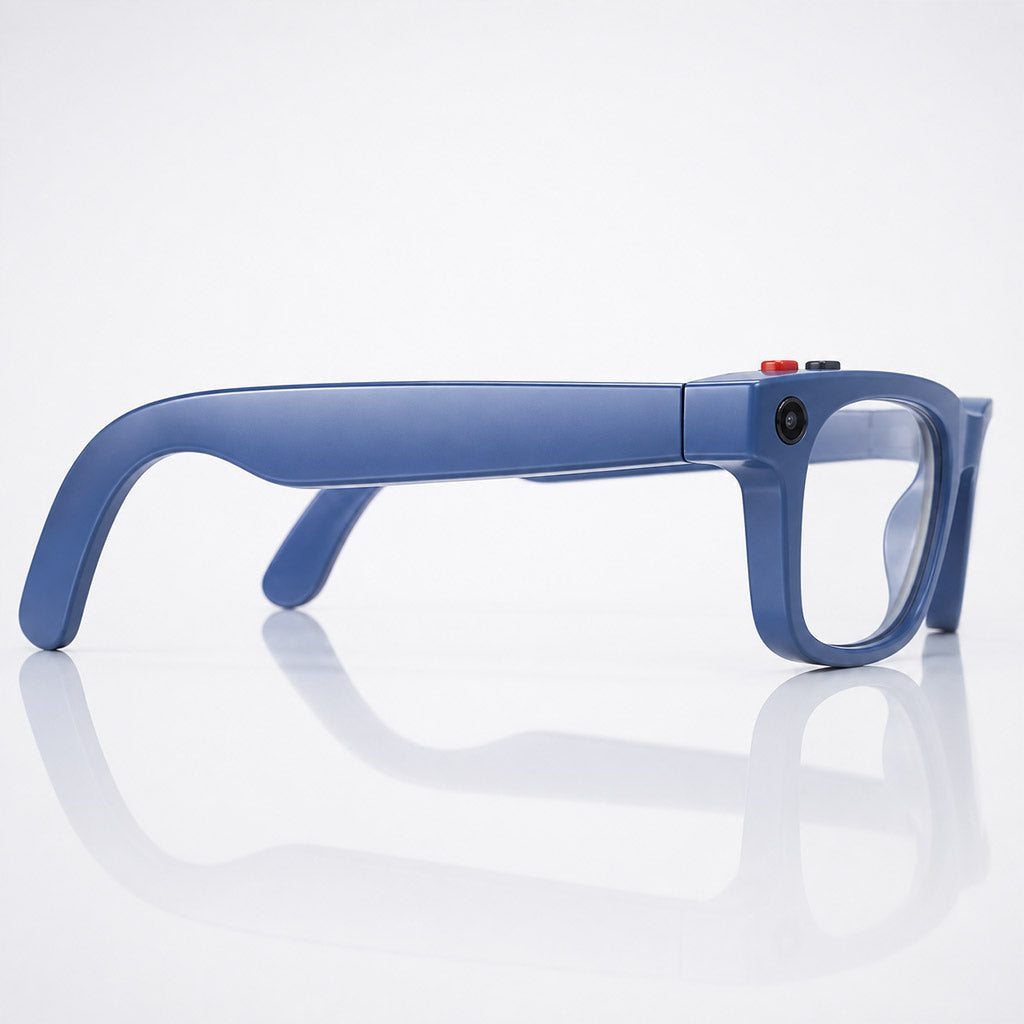
The camera lens sits at the hinge and is visible up close. That is deliberate, and it is the correct trade. A camera nobody can see is a camera nobody agreed to.
The practical consequence is availability. A frame that draws no comment is on your face at four in the afternoon on an ordinary Tuesday, when something happens that nobody put in a calendar. Every other option in this category fails at exactly that hour.
In practice the first week looks unremarkable, and that is the point. They go on with the rest of your things in the morning. Two or three times a day something happens worth keeping, and a tap on the temple keeps it. Nobody at the table asks what you are wearing.
05
There is a light on the front, and history says it is the most important part
Read against the reason before it, this one looks like a contradiction. Reason four argued the frame should draw no comment. This one argues the camera should announce itself. Both are true, and the distinction is the whole ethic of the category: the frame is discreet, the recording is not.
Discreet means it gets worn on an ordinary day. Covert means the people around you never agreed. A product that blurs those two has picked the wrong customer.
The first widely sold camera glasses did not fail on image quality. They failed socially, and quickly, because the people nearby could not tell whether they were being recorded. The backlash was strong enough to end the product, and it had nothing to do with the sensor.
A front facing indicator light comes on whenever the camera is running, pointed outward, toward whoever is in frame. Anyone opposite can see it without asking. That is the only arrangement under which glasses like these are comfortable to wear around other people.
- Front facing indicator light, lit whenever the camera runs
- Visible to the person opposite, not only to the wearer
- Capture runs in short sessions. These do not roll continuously all day.
- Photos and video move to your phone over Wi-Fi through the companion app. No cable and no card reader.
- Recording rules differ by state and by venue, and some places do not allow cameras at all. Knowing the room stays your responsibility.
06
Clear indoors, tinted outdoors, and the arithmetic behind why that matters
Most camera sunglasses cannot be worn indoors. Work out what that removes. Office hours are gone. Every evening is gone. Restaurants, shops, homes and anything after sunset are gone.
What remains is daylight outdoors, which for most people is a couple of hours on a normal day and a full week twice a year. That is how a camera becomes a holiday object, and holiday objects live in drawers.
The everyday frame ships with a clear lens and two clip on tinted sets. Three lens states cover an office, a walk at midday and the drive home without swapping frames or carrying two cases.
07
A menu you cannot read stops being an obstacle, and the cost works out under $10 a month
Live translation across 25 languages is the feature that convinces sceptics on the first trip. Look at a menu, ask for it in English, hear the answer. Or hold a conversation and have it translated while it happens.
Two limits stated plainly. It runs through the companion app on your phone, so it needs a connection. Accuracy moves with the language and with how loud the room is. It helps while travelling and it does not replace an interpreter. Translation is also on the everyday frame only. The Vira Ride cycling frame does not include it.
What changes on a trip is not the number of photographs. It is that reading a sign, ordering a meal and asking directions stop requiring a phone in your hand on an unfamiliar street, which is the situation most travellers are told to avoid.
Choosing
Two frames, same price, and picking wrong is the usual regret
Translation is only on the everyday frame. Check this row before ordering.
| Vira Sight AI | Vira Ride | |
|---|---|---|
| Built for | Daily wear, travel, work | Cycling, commuting |
| Frame | Classic square | Wraparound shield |
| Lens | Clear plus 2 clip on sets | UV400 polarised mirror |
| Camera | 5MP, 1080p anti shake | 8MP |
| Live translation | 25 languages | Not included |
| Colourways | 3 | 5 |
| Price | $114 | $114 |
Straight answers
What these do, and what they don't
Most pages selling smart glasses leave this out. Reading it before ordering is cheaper for both sides than a return.
What is included
- 5MP stills and 1080p video with anti shake, hands free
- Live translation across 25 languages through the companion app
- Clear lens plus two clip on tinted sets
- Front facing recording indicator light
- Wi-Fi transfer to your phone, no cable and no card reader
- 12 month warranty and a 30 day return window
What these are not
- No screen or display in the lens. Nothing is projected in front of your eye.
- No directions appear in view. Navigation, if used, is audio through your phone.
- Translation and assistant features require a phone and a connection.
- Capture runs in sessions, not continuously all day.
- Not a replacement for a dedicated camera where image quality is the priority.
- Not for swimming or submersion.
Before you spend anything
Four people who should not buy these
Saying this costs a few orders and saves a great many returns.
- Anyone who wants a heads up display. Nothing is projected in the lens. That is a different category and it costs several times more.
- Anyone whose priority is image quality. A dedicated camera wins on every optical measure. These win on being present when it matters.
- Anyone who will only wear them on holiday. Reason six is the argument, and it applies here too. Twice a year is how drawers get filled.
- Anyone uncomfortable saying there is a camera on their face. The indicator light means the question will come up occasionally. If that sounds tiring, this is not the product.
From buyers
What people report after a few weeks
★★★★★
{{T1_QUOTE}}
{{T1_NAME}} · {{T1_LOCATION}} · Verified buyer★★★★★
{{T2_QUOTE}}
{{T2_NAME}} · {{T2_LOCATION}} · Verified buyer★★★★★
{{T3_QUOTE}}
{{T3_NAME}} · {{T3_LOCATION}} · Verified buyerRisk free
30 days to decide. Full refund. Shipped and supported from the United States.
Wear them for thirty days. If they end up in a drawer, email support for a refund inside the return window. The guarantee exists because the argument on this page is about daily wear, and thirty days is long enough to find out.
On price, do the division. $114 covers the frame, the clear lens, both clip on tinted sets and twelve months of warranty. Across that warranty period it works out under ten dollars a month. A single pair of non prescription sunglasses from a mall optician usually costs more than that and does one job.
Vira Sight is operated by Godly Grind LLC, a registered US company in Cheyenne, Wyoming, with a published street address, a working phone number and a support inbox. In a category full of anonymous listings, that is checkable.
- 30 day return window, requested by email
- 12 month warranty against defects
- Free shipping on orders over $150
- Orders processed in 1 to 3 business days. US delivery typically 3 to 7 days.
- Ships to the US, Canada, UK and EU, Australia and New Zealand
Questions
Before you order
Will people know when the camera is recording?
Yes. A front facing indicator light comes on whenever the camera is running, and the person opposite can see it.
Is there a display inside the lens?
No. Nothing is projected in front of your eye. Anything you would normally read comes back as audio, or appears in the companion app on your phone.
Do they work without a phone?
The camera works on its own. Translation and assistant features run through the companion app, so those need a phone nearby and an internet connection.
How do photos get onto my phone?
Over Wi-Fi through the companion app. No cable and no card reader.
Can I get prescription lenses fitted?
The frame accepts replacement lenses, so an optician can usually fit prescription lenses. Check with yours first, and contact us before ordering if that is your plan.
Shipping, returns and warranty
Orders are processed in 1 to 3 business days. US delivery typically takes 3 to 7 days from the US warehouse, or 7 to 15 days when an item ships from an overseas warehouse. These are estimates rather than guaranteed delivery dates.
Returns are accepted within 30 days by email request, and every frame carries a 12 month warranty against defects. Full terms are on the returns and shipping pages.
Vira Sight AI Smart Glasses
Go back to watching things happen
The conflict was never about image quality. It was that capture and attention wanted the same hand. Move the camera to your face and the conflict disappears. That is the entire argument, and thirty days is long enough to find out whether it holds.
$114
Shop Vira Sight AI30 day returns · 12 month warranty · Free shipping over $150
Vira Sight, operated by Godly Grind LLC,
1021 E Lincolnway, Suite #8481, Cheyenne, WY 82001, USA
support@virasight.com · +1 (479) 345-8188
Privacy · Terms · Shipping · Returns · Contact
This is a paid advertisement produced and published by Vira Sight for its own product. It is not editorial content from an independent publication, and no third party publisher has reviewed or endorsed this product. Vira Sight AI Smart Glasses are a camera and audio accessory. They are not a medical or vision correction device and no health claim is made. They do not include a display and do not project images into your field of view. Translation requires a connected phone and an internet connection, and accuracy varies by language and conditions. Battery life depends on use. Recording laws differ by state and venue, so please use them responsibly.